
Riiai SG003A
4.4Editor score
4-20mA Current Signal
2.4 Inch TFT Screen
USB Rechargeable Battery
This expert guide compares the top ten Amfm Signal Generator models for reliability, frequency range, and modulation features to help you choose the right test
Finding the right Amfm Signal Generator is crucial for engineers and hobbyists who need precise waveform control. Whether you are testing radio receivers or calibrating circuits, a reliable generator ensures accurate results every time without frustrating signal noise.
We evaluated ten leading models based on frequency range, modulation types, and build quality. Our analysis focuses on real-world performance, user interface clarity, and the versatility each unit offers for both laboratory and field applications across various industries.
Each pick highlights specific strengths like dual-channel output or compact portability for diverse testing needs. Please note that availability and specifications can change over time, so verify the latest details before making your final purchasing decision today.
4.4Editor score

5.0Editor score

5.0Editor score
The following table provides a side-by-side comparison of all ten selected models to help you quickly identify the specifications that matter most for your specific testing requirements and budget constraints.




The UNI-T UTG962E stands out as a top contender for anyone needing a reliable Amfm Signal Generator. With a perfect five-star rating from users, this handheld unit delivers professional-grade performance in a surprisingly small package that fits easily into a toolkit.
We may earn a commission when you buy through this link, at no additional cost to you.
Its key strengths lie in its versatility and ease of use. The device supports dual-channel output with a wide range of waveforms including sine, square, and arbitrary types. You can store up to twenty-four non-volatile digital arbitrary waveforms, which is ideal for repeated testing scenarios in electronics labs.
While the 60 MHz limit might not suit ultra-high-frequency RF work, it covers the vast majority of hobbyist and educational needs. The included accessories like BNC cables and a power adapter mean you can start testing immediately without buying extra items.
This generator is perfect for electronics enthusiasts who value portability without sacrificing core functionality. If you need a high-performance tool for general waveform generation and modulation tasks, this model offers the best balance of features and size available today.
The mini palm-sized design allows engineers to carry the generator to remote test sites without burdening their equipment load significantly.
Support for AM FM PM and FSK modulation ensures you can simulate real-world signal conditions for comprehensive communication system testing.
We may earn a commission when you buy through this link, at no additional cost to you.
The OWON DGE2035 is an excellent choice for educational training and research labs where visual feedback is essential. Its large color screen displays real-time waveform status making it easy to monitor signal quality during complex experiments without external monitors.
We may earn a commission when you buy through this link, at no additional cost to you.
This unit offers robust modulation options including AM FM and FSK which are critical for testing communication systems. The ability to connect to a PC allows for remote control and automation, streamlining workflow in professional environments where efficiency matters.
Although the 35 MHz frequency range is lower than the UTG962E, the high sampling rate and resolution ensure signal fidelity for most audio and RF applications. Users appreciate the straightforward interface which reduces setup time for routine testing tasks.
Ideal for students and engineers who need a reliable workstation generator, this model bridges the gap between benchtop performance and user-friendly operation. It is a solid investment for any lab requiring consistent signal generation with minimal configuration overhead.
The TFT color screen provides immediate visual confirmation of waveform settings helping users catch errors before they affect downstream circuits.
USB PC control enables integration into automated test sequences which is vital for high-volume production or repetitive research protocols.
We may earn a commission when you buy through this link, at no additional cost to you.
This 6-Band Signal Generator is built for durability in demanding maintenance environments. The high-class metal and plastic construction ensures the unit can withstand bumps and drops that often occur in field service situations without compromising functionality.
We may earn a commission when you buy through this link, at no additional cost to you.
The device covers a broad spectrum from 100KHz to 150MHz allowing it to handle various radio testing scenarios. Its low phase noise characteristic is particularly valuable for maintaining signal purity which reduces interference during precise calibration tasks.
While it lacks the digital sophistication of more expensive models, the straightforward knob and button layout make it accessible for quick adjustments. You do not need to reassemble parts before use just connect power and start generating signals immediately.
Technicians looking for a rugged tool for general electronic equipment maintenance will find this generator practical and reliable. It is an excellent option when portability and physical robustness are more important than advanced programmable features.
The sturdy build design protects internal components from damage ensuring the device remains functional over years of daily heavy use.
Low phase noise helps maintain clean signals which is critical when testing sensitive radio receivers that might pick up noise artifacts.
We may earn a commission when you buy through this link, at no additional cost to you.
The Upgraded RF Signal Generator offers an impressive frequency range extending up to 4400MHz making it suitable for diverse wireless applications. This broad coverage allows engineers to test modern wireless standards that require higher frequency signals than standard generators provide.
We may earn a commission when you buy through this link, at no additional cost to you.
Its ability to save parameters when powered off ensures you do not lose settings between sessions. This feature is convenient for field work where devices are frequently turned off and on to conserve battery life during extended use.
While the unit is limited to sine waves without complex arbitrary waveforms, its simplicity often appeals to users focused on basic signal injection tasks. The power flexibility means you can run it from a computer or portable charger anywhere.
If your primary need is reaching high frequency bands without breaking the bank, this model provides a cost-effective entry point. It is best suited for applications where basic sine wave output is sufficient and high-frequency coverage is the priority.
Supporting signals up to 4400MHz enables testing of modern wireless protocols and RF circuits that standard generators cannot reach.
Compatibility with mobile chargers and power banks ensures continuous operation even when grid power is unavailable in remote locations.
We may earn a commission when you buy through this link, at no additional cost to you.
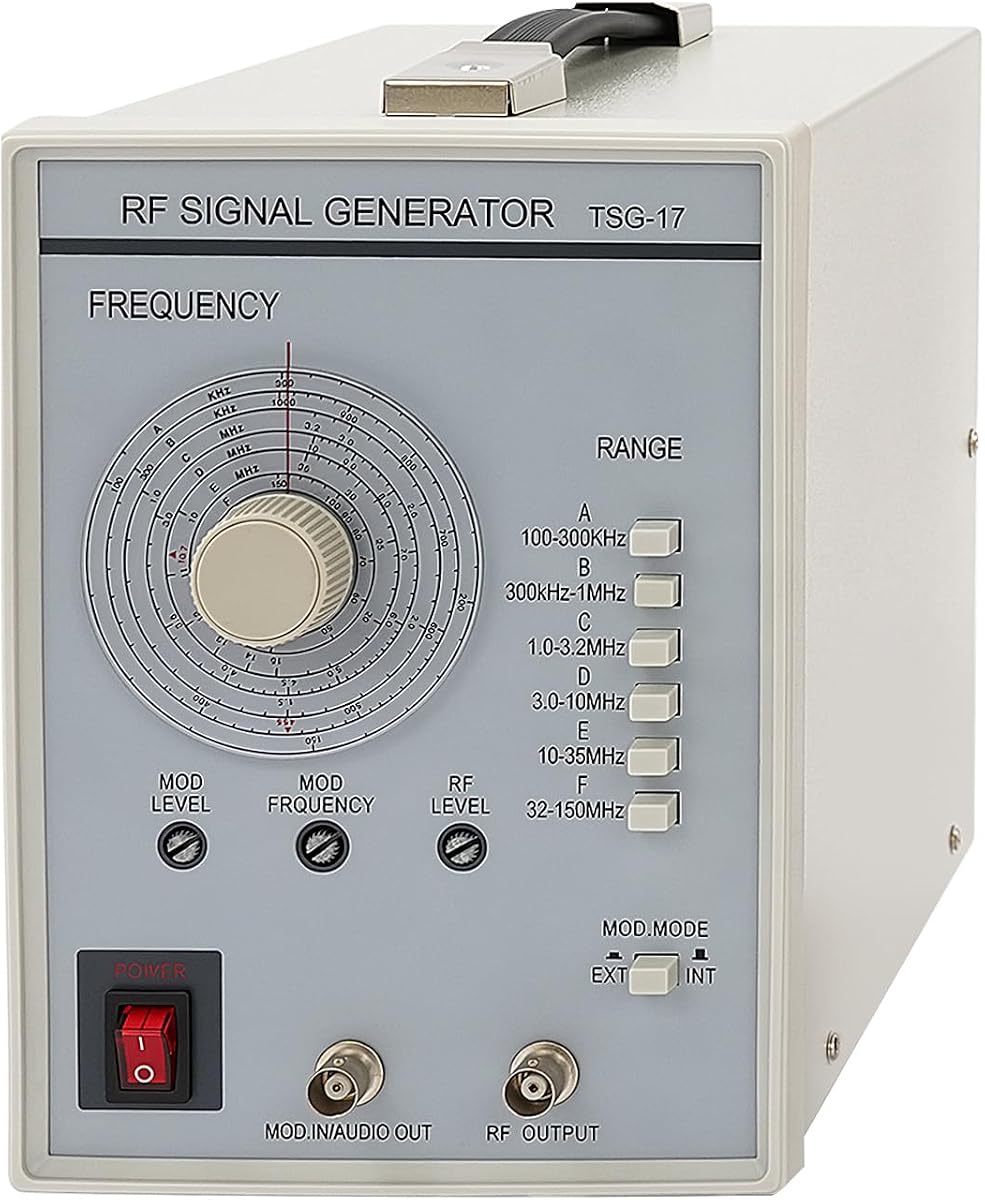
The TSG-17 is positioned as a commercial-grade unit for household and professional environments. Its high accuracy rating suggests it is built to meet stringent calibration standards required in more formal testing setups.
We may earn a commission when you buy through this link, at no additional cost to you.
This generator supports output control from 1mV to 100m which provides a range of signal strengths for different load conditions. The ability to produce harmonics up to 450MHz adds versatility for testing frequency multiplier circuits.
Users should note the lower rating compared to other models which may indicate variability in performance or build quality. It remains a functional option for those who need basic RF signal generation with specific amplitude control features.
For commercial applications requiring a steady 110V power source this model offers a straightforward solution. It is suitable for users who prioritize amplitude control and harmonic testing over advanced waveform programmability.
The design focuses on consistent output for commercial environments where reliability over time is key for maintaining testing standards.
Wide output control allows precise adjustment of signal levels ensuring compatibility with a variety of sensitive input circuits.
We may earn a commission when you buy through this link, at no additional cost to you.
This Adjustable Signal Generator is tailored for industrial loop testing where precise current and voltage simulation is necessary. The ability to output 4-20mA signals makes it ideal for calibrating control systems used in process automation environments.
We may earn a commission when you buy through this link, at no additional cost to you.
It features a built-in lithium battery that supports portable use away from the bench. Although charging takes several hours, the ability to operate for hours without a wall outlet is valuable for field technicians needing flexibility during inspections.
The PWM output function adds versatility for testing frequency-sensitive devices. Short circuit protection ensures safety during connection and disconnection phases which protects both the tool and the equipment under test from accidental damage.
Engineers focused on process control and valve testing will find this unit practical and efficient. It simplifies the task of simulating sensor signals without needing a dedicated multi-tool for every measurement type.
The 4-20mA standard output ensures compatibility with most industrial control systems and transmitters used in automation.
Internal battery power removes dependency on wall outlets allowing technicians to test remote loops efficiently and safely.
We may earn a commission when you buy through this link, at no additional cost to you.
The Riiai 0-10V offers a compact solution for voltage and current signal generation with a clear digital display. Its high precision and adjustable output make it a reliable choice for fine-tuning control systems where exact values are required.
We may earn a commission when you buy through this link, at no additional cost to you.
Users can switch between voltage and current modes easily using the encoder knob and mode button. The 4-digit display ensures that small changes in output are visible allowing for highly accurate adjustments during critical testing phases.
While the unit is small it includes safety features like reverse connection and short circuit protection. This design ensures durability even when handling live wires in environments where accidental contact might occur during setup.
Ideal for PLC panel debugging and light dimmer testing this model provides an easy-to-carry tool for industrial technicians. Its straightforward operation reduces the learning curve for users new to signal simulation tasks.
The 4-digit readout allows users to verify exact output values without guesswork improving testing accuracy and repeatability.
Switchable voltage and current modes enable testing of various industrial devices without needing separate instruments for each function.
We may earn a commission when you buy through this link, at no additional cost to you.
The Riiai SG003A stands out for its advanced display capabilities featuring a real-time curve view of signals. This visual feedback helps users understand signal behavior dynamically which is beneficial for analyzing complex interactions in automated systems.
We may earn a commission when you buy through this link, at no additional cost to you.
With a large 3000mAh battery this unit supports extended field work without frequent recharging. The programmable output modes allow for automated signal sweeps that can save significant time during repetitive calibration processes.
While the interface offers many options it might take time to master for users new to advanced signal generators. However the feature set provides excellent value for the price compared to other models with similar display quality.
This model is ideal for budget-conscious engineers who need high-end features like curve visualization and auto modes. It is particularly well-suited for PLC testing where dynamic signal analysis can reveal system issues effectively.
The real-time curve display helps technicians spot signal anomalies instantly which speeds up troubleshooting and system validation.
A large battery capacity ensures the device lasts through entire shifts reducing downtime for charging during critical maintenance windows.
We may earn a commission when you buy through this link, at no additional cost to you.
The DROK 4-20mA Generator offers a simplified approach to signal generation using a multi-cycle potentiometer for precise adjustments. This analog control method is intuitive and fast which is excellent for quick tests where digital menus would slow you down.
We may earn a commission when you buy through this link, at no additional cost to you.
Its design combines current and voltage generation into one module reducing the need for multiple tools during complex troubleshooting sessions. This integration keeps the workspace clean and ensures you have the right signal source available immediately.
While it lacks the advanced features of programmable generators, its simplicity ensures reliability in rugged environments where digital interfaces might fail. The small size makes it easy to keep in a toolbox for immediate access.
Technicians who prefer tactile control over screen menus will appreciate this straightforward tool. It is a practical choice for routine value adjusting and LED testing tasks where basic signal simulation is sufficient.
The analog potentiometer allows for smooth and direct adjustments without navigating complex digital menus during quick tests.
Combining current and voltage modules into one device simplifies carrying and storing tools for efficient field maintenance work.
We may earn a commission when you buy through this link, at no additional cost to you.
The SEESII Dual Channel generator represents the premium end of the market with fully independent channels and high precision specs. Its DDS technology ensures low distortion signals which are critical for accurate circuit simulation and design verification tasks.
We may earn a commission when you buy through this link, at no additional cost to you.
With sixty built-in arbitrary waveforms this unit satisfies complex circuit simulation demands efficiently. The ability to adjust phase differences continuously makes it ideal for testing differential circuits where timing relationships between signals are critical.
The seven-in-one functionality integrates multiple instruments like a frequency meter and counter into one device. This consolidation saves desk space and reduces equipment costs for engineering labs that need versatility without clutter.
R&D engineers and university labs will find this generator an invaluable asset for advanced testing. While the price is higher, the performance and feature set justify the investment for professional applications requiring high accuracy and flexibility.
Two equal performance channels allow simultaneous generation of different waveforms essential for differential circuit testing.
Integrating seven device functions into one unit simplifies the lab setup and ensures all tools are calibrated together.
We may earn a commission when you buy through this link, at no additional cost to you.
Selecting the right generator requires understanding your specific frequency and modulation needs.
The frequency range determines the types of circuits you can test. For general electronics and audio work, a range up to 60MHz is often sufficient. However, if you are testing RF systems or modern wireless protocols, you may need a model that extends into the hundreds of MHz or even GHz to cover high-bandwidth signals effectively.
Ensure the generator covers the frequencies required for your most common testing scenarios to avoid limitations in your future projects.
Modulation capabilities allow you to simulate real-world signal conditions. Standard models support Amplitude Modulation (AM) and Frequency Modulation (FM) which are essential for radio receiver testing. Advanced units might include Phase Modulation (PM) and Frequency Shift Keying (FSK) for digital communication testing.
Choose a device that supports the specific modulation types required by your industry standards or application protocols.
Single channel generators are sufficient for basic waveform generation but dual-channel units offer significant advantages. Dual channels allow you to compare signals or test differential circuits simultaneously. This feature is vital for advanced engineering tasks where signal relationships matter.
Opt for dual channels if you need to generate two independent or synchronized signals to streamline complex testing workflows.
Field technicians need portable tools that can operate without constant access to power outlets. Models with built-in rechargeable batteries allow for mobility across different testing sites. Consider the battery life and charging time to ensure the device lasts through your workday without interruptions.
Select a portable unit with long battery life if your work involves frequent movement between locations or remote field sites.
A clear display helps you monitor settings and waveforms accurately. TFT color screens provide better visibility of real-time data compared to basic LCDs. User-friendly controls such as knobs and shortcut keys reduce setup time and minimize configuration errors during testing.
Look for a model with a large display and intuitive controls to ensure efficient operation and quick access to settings.
High resolution and frequency accuracy ensure that your output signals are precise. This is critical when testing sensitive components that rely on exact timing or voltage levels. Look for units with high bit resolution and low phase noise to maintain signal purity and integrity.
Prioritize high resolution and accuracy to ensure your test results are reliable and your equipment receives the correct signals.
Connectivity options like USB allow for PC control and remote automation. This feature is useful for labs where test sequences need to be automated or logged digitally. Ensure the generator supports standard interfaces to integrate easily with your existing software ecosystem.
Choose a model with USB or digital connectivity if you plan to automate tests or monitor signals remotely via a computer.
Physical build quality affects how well the device survives regular use. Units with metal housings and scratch-resistant finishes are better suited for harsh environments. Check for features like short-circuit protection to ensure safety during routine testing procedures.
Select a robust device with protective features to ensure it withstands daily use in both lab and field conditions safely.
Start by connecting the generator to a stable power source or ensuring the battery is fully charged before use. Connect the output cables securely to the device under test to prevent intermittent contact that could lead to inconsistent signal readings during experiments.
Set the desired frequency and modulation parameters using the front panel controls. Always verify the output on an oscilloscope if available to ensure the signal matches your intended settings before applying it to sensitive circuits or equipment.
Store the generator in a dry and cool place to protect the internal electronics from humidity and heat damage. Regularly clean the vents and ports to prevent dust buildup that could interfere with ventilation or connection quality over time.
An Amfm Signal Generator is primarily used to create specific audio or radio frequency signals for testing equipment. Engineers use these devices to check the performance of amplifiers, radios, and communication systems by feeding them known test signals.
AM modulation varies the signal amplitude while keeping frequency constant whereas FM modulation varies the frequency while keeping amplitude constant. Each method has different applications depending on the transmission standards you need to test or simulate in your system.
Many modern generators cover both audio and RF ranges allowing them to be used for various testing needs. However check the frequency range specifications to ensure the unit covers the specific bands required for your audio or RF projects.
Higher resolution ensures that the generated waveform is smooth and precise without unwanted steps or distortion. This is critical for accurate testing because low resolution can introduce artifacts that interfere with your results or damage sensitive components.
Most standard packages include power adapters, USB cables, and BNC test cables for immediate use. Some models might also include specific probes or software for PC control but you should check the product description for exact inclusions.
Calibration often requires using an external precision instrument like an oscilloscope or frequency counter. You adjust the generator settings to match the reference measurements to ensure the output remains accurate over time for reliable testing results.
Our selection of ten models highlights the diversity available across performance tiers and use cases. Whether you prioritize portability like the UNI-T UTG962E or advanced features like the SEESII Dual Channel, there is a unit suited for your specific workflow.
Focus on the factors that matter most to your projects such as frequency range and modulation types. Investing in a device that aligns with your current needs while allowing room for growth will provide the best long-term value for your testing setup.
Remember to verify current specifications and availability before making a purchase decision. Conditions and product availability can shift so always check the latest details to ensure you are getting the right tool for your work.