
Creality Pika
5.0Editor score
0.03mm high accuracy
Wi-Fi 6 wireless
AI body completion
3D scanners have transformed how we capture reality, turning physical objects into digital models with incredible precision. Whether you need reverse engineering, creative design, or quality inspection, the right tool matters immensely for success.
We analyzed ten leading models based on accuracy, speed, connectivity, and software capabilities. Each entry offers unique strengths, from budget-friendly hobbyist units to industrial-grade systems for professional workflows and demanding environments.
Every pick highlights key specs, pros, and cons to guide your decision. Prices fluctuate often, so verify current offers before buying to ensure you get the best value for your specific needs and budget.
5.0Editor score
4.8Editor score

4.9Editor score
As an Amazon Associate we earn from qualifying purchases.
This table compares key specs across all ten models. Check accuracy, speed, and modes to find the device that fits your specific scanning requirements and workflow constraints.


The Creality Pika stands out as a top performer for both hobbyists and professionals needing portable precision. With a 5.0 rating from users, it offers 0.03mm accuracy and 110 FPS scanning speed in a pocket-sized body.
We may earn a commission when you buy through this link, at no additional cost to you.
Its dual-mode system switches between blue laser for fine details and NIR structured light for full-body scans. The built-in AI completes body models in seconds and repairs holes automatically, saving hours of manual cleanup.
Wireless freedom via Wi-Fi 6 lets you scan without cables, while the 3-inch touchscreen provides instant previews. Black and metal surfaces scan without spray, which is rare at this price point.
This scanner is perfect for reverse engineering, 3D printing, and digital archiving. Its lightweight design and high accuracy make it the best all-around choice for 2026 projects.
AI body completion generates full models from face scans in 10 seconds, while retexuring adds real photo textures for lifelike results.
At only 260g with Wi-Fi 6 and swappable batteries, it scans from 10mm miniatures to 2m objects anywhere outdoors up to 110,000 lux.
We may earn a commission when you buy through this link, at no additional cost to you.
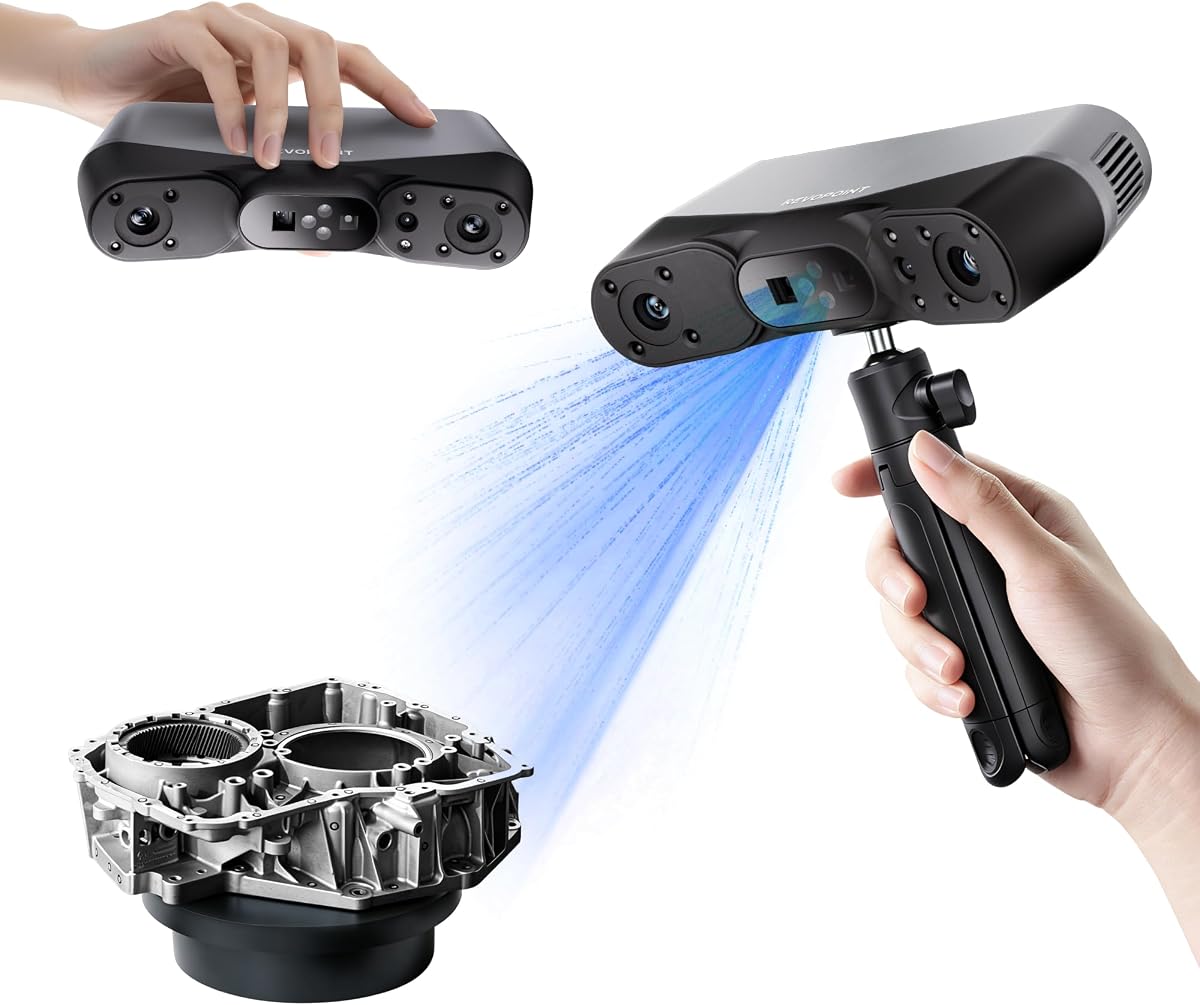
The Revopoint POP 4 delivers industrial-grade accuracy with a 0.03mm single-frame rating. Its premium build and five scanning modes handle everything from small precision parts to large industrial components with exceptional consistency.
We may earn a commission when you buy through this link, at no additional cost to you.
AI segmentation identifies targets in one click and filters background noise automatically, streamlining post-processing. Outdoor performance is unmatched, maintaining stability in up to 100,000 lux ambient light for fieldwork.
High frame rates ensure smooth scanning with NVIDIA GPU acceleration, while VCSEL mode covers larger distances. The ergonomic battery grip supports four hours of continuous use without power outlets.
Ideal for reverse engineering and 3D printing, this scanner combines speed and precision. Its all-weather capability makes it the top premium choice for professionals.
With 0.03mm accuracy and five modes including hybrid HD and VCSEL, it faithfully reproduces finest surface details and complex geometries.
Multi-line laser and VCSEL modes operate up to 100,000 lux, enabling reliable scanning for construction sites and archaeological digs.
We may earn a commission when you buy through this link, at no additional cost to you.
The INSPIRE 2 offers a budget-friendly entry without compromising on essentials. At 0.05mm accuracy and 190g, it is lightweight yet powerful enough for hobbyists and small businesses needing reliable portable scanning.
We may earn a commission when you buy through this link, at no additional cost to you.
Its infrared laser lines capture dark and reflective surfaces without spray, while adjustable optical zoom focuses on fine details across various sizes. Wi-Fi 6 enables real-time streaming to mobile devices for remote operation.
Aerospace-grade aluminum ensures durability for field use, with outdoor filters allowing scans up to 20,000 lux. The included turntable and markers simplify setup for beginners.
For those seeking value and portability, this model delivers. It handles different materials and environments effortlessly, making it the best budget option for versatile 3D printing needs.
11 infrared laser lines capture details on reflective or dark surfaces without spray, ensuring cleaner models and faster workflows.
At just 190g with Wi-Fi 6 and optical zoom, it scans up to 20,000 lux outdoors with flexible remote operation and streaming.
We may earn a commission when you buy through this link, at no additional cost to you.
MetroY Ultra excels with 0.01mm precision and industrial-grade blue laser for tight tolerance measurement. Its five scanning modes handle every scenario from small parts to medium objects, ensuring flawless detail capture for inspection.
We may earn a commission when you buy through this link, at no additional cost to you.
Scanning reaches 90 FPS with NVIDIA GPU, and outdoor capability up to 100,000 lux allows use in harsh sunlight. No-spray scanning protects delicate parts and saves prep time for shiny or black surfaces.
Wireless Wi-Fi 6 control via Revo Mirror gives flexibility without cables. The included battery grip provides 2.5 hours of power for extended field work sessions.
This scanner is built for industrial inspection and reverse engineering where accuracy is non-negotiable. Its robust performance and outdoor resilience make it a top-tier choice for professionals.
Up to 90 FPS scanning speed enables large-area captures quickly, reducing data acquisition time and boosting productivity without compromising quality.
Powerful laser modes capture parts in sunlight up to 100,000 lux, with Wi-Fi 6 wireless freedom and battery grip for 2.5 hours continuous use.
We may earn a commission when you buy through this link, at no additional cost to you.
MetroX Pro delivers industrial-grade blue laser precision with 0.01mm accuracy, ideal for reverse engineering and measurement. Its four scanning modes capture fine features or large surfaces efficiently, meeting demanding modeling needs.
We may earn a commission when you buy through this link, at no additional cost to you.
One-click automatic turntable scans automate complex objects, while PC-to-mobile streaming lets you detect gaps without holding a laptop. Shiny or dark surfaces scan effortlessly without spray at 2,000,000 points per second.
Three tracking modes adapt to flat, feature-rich, or complex shapes, enhancing versatility. The HD RGB camera adds vivid color for realistic visualization in Auto Turntable mode.
This scanner is perfect for industrial inspection and creative design. Its robust software integration and automation make it the best for reverse engineering workflows.
Auto turntable mode automates complex scans, while real-time streaming allows gap detection and movement without holding the laptop.
With 0.01mm accuracy and three tracking modes, it handles flat and complex shapes for industrial inspection and design.
We may earn a commission when you buy through this link, at no additional cost to you.
The 3DMakerpro Fox offers a budget-friendly, accessible solution for beginners and hobbyists. At 0.07mm accuracy, it outperforms typical entry-level scanners, capturing detail useful for 3D printing and modeling.
We may earn a commission when you buy through this link, at no additional cost to you.
Markerless AI visual tracking relocks onto objects quickly if you move too fast, preventing the need to restart scans. JMStudio software integrates scanning, editing, and optimizing into one seamless process.
While lower-rated due to entry-level limitations, its precision holds up under scrutiny for personal projects. It simplifies the hard parts of 3D scanning for users new to the field.
Ideal for those entering 3D printing, this scanner balances cost and performance. Its AI features make it forgiving and reliable for casual use.
Markerless AI visual recognition relocks onto scanned areas in seconds, allowing you to move at your own pace without restarting.
JMStudio integrates scanning and editing into one process, handling post-processing tasks so you can focus on results.
We may earn a commission when you buy through this link, at no additional cost to you.
The Otter Lite uses a unique quad-camera system to handle objects from 0.8 inches to 78 inches. With 0.05mm accuracy and DOE structured light, it delivers high precision and color fidelity for various applications.
We may earn a commission when you buy through this link, at no additional cost to you.
Its 24-bit full color capture reproduces vibrant textures using RGB and white LED lights. Dark or shiny surfaces scan without spray, while Class I laser safety allows full-body scans in one minute.
30 FPS speed ensures efficient workflows, and Wi-Fi 6 connects to mobile devices. Optional accessories like the Scan Bridge provide stability during extended sessions.
This scanner is ideal for automotive parts, machinery, and product design. Its large coverage and color accuracy make it a standout for diverse scanning tasks.
Dual long-focal lenses handle fine details while short-focal lenses cover large ranges from coins to cars with minimal setup.
24-bit full color with 2 white LEDs and eye-safe infrared light allows vibrant, accurate scans of objects and human subjects safely.
We may earn a commission when you buy through this link, at no additional cost to you.
The CR-Scan Ferret SE offers accessible scanning with 0.1mm accuracy and 30 FPS speed. Its anti-shake tracking technology significantly increases success rates, making it ideal for beginners with shaky hands or rapid movements.
We may earn a commission when you buy through this link, at no additional cost to you.
The 2MP color camera captures vivid textures in original colors. A flexible scanning range handles medium to large objects up to 2000mm efficiently with a single capture range of 560*820mm.
Dark and metal objects scan without spray, simplifying prep. However, accuracy falls below premium models, and software may be limited to specific systems.
Perfect for entry-level projects, this scanner ensures smooth results. Its tracking and color features make it reliable for casual users and learners.
One-shot 3D imaging enhances tracking efficiency and success rates, ensuring error-free scanning even with shaky hands or rapid movements.
With 2MP color capture and flexible range up to 2000mm, it handles medium to large objects efficiently without spraying surfaces.
We may earn a commission when you buy through this link, at no additional cost to you.
The CR-Scan Ferret Pro enhances mobility with advanced Wi-Fi 6 transmission. Three times faster than Wi-Fi 5, it ensures stable data transfer for precision scanning. It scans up to 30,000 lux outdoors with improved optical technology.
We may earn a commission when you buy through this link, at no additional cost to you.
Anti-shake tracking ensures smooth results with hand movements, while 30 FPS and 0.1mm accuracy provide reliable performance. Export formats like OBJ and STL integrate seamlessly with 3D printing workflows.
System compatibility extends to iOS and Android via the bridge, unlike the SE. Avoid scanning highly reflective or transparent surfaces for optimal results.
Ideal for mobile scanning needs, this model balances wireless convenience with accuracy. Its broad device support makes it flexible for diverse users.
Three times faster data transfer ensures stable and efficient scanning for high-precision tasks with wireless freedom.
Supports Android and iPhone via Wi-Fi 6 bridge and USB, offering broader device compatibility than previous models.
We may earn a commission when you buy through this link, at no additional cost to you.
The MIRACO Plus is a comprehensive all-in-one scanner with integrated photogrammetric metrology. Its quad depth camera system and 0.04mm accuracy handle everything from tiny screws to large machinery.
We may earn a commission when you buy through this link, at no additional cost to you.
A 6-inch 2K AMOLED flip screen provides perfect views from any angle, while the 8-core processor and 32GB RAM enable rapid project processing. The photogrammetric kit ensures high-resolution capture on large objects.
Dual modes support single-shot for accuracy or fast continuous 20 FPS scans. Fast charging and lightweight portable design enhance field usability significantly.
This scanner is ideal for professionals needing metrology and CAD conversion. Its hardware and software integration make it the top all-in-one choice.
With 32GB RAM and 8-core processor, it processes scans quickly and supports hybrid photogrammetric capture for complex measurements.
The photogrammetric kit ensures length accuracy of 0.02 mm plus 0.05 mm times length for precise large-object capture.
We may earn a commission when you buy through this link, at no additional cost to you.
Selecting the right scanner depends on accuracy needs, environment, and budget.
Accuracy determines how closely the digital model matches the real object. Industrial applications require 0.01mm to 0.03mm, while hobbyist projects may only need 0.05mm or higher.
Always check single-frame accuracy rather than just overall specs.
Faster frame rates reduce scanning time and improve comfort during long sessions. Look for 30 FPS or higher for efficiency, especially with large objects.
NVIDIA GPU acceleration can boost speed significantly in compatible models.
Wireless Wi-Fi 6 offers freedom from cables but requires stable connections. Wired options ensure reliability for complex industrial workflows or large data transfers.
Cross-platform support expands usability across different devices.
Outdoor scanning demands resistance to sunlight. Models rated for 50,000 to 100,000 lux maintain performance in bright environments.
Indoor models may struggle outside without external filters.
Avoid spraying dark or reflective surfaces when possible. Blue laser or structured light modes handle these materials directly, saving time and prep effort.
Check if spray is needed for specific materials.
Software affects workflow ease. Revo Scan and CrealityScan offer tools for editing and exporting. Ensure compatibility with your CAD or 3D printing software.
Some advanced features require paid add-ons.
Battery life impacts portability. Look for 2 to 4 hours of continuous operation for field work without access to outlets.
Swappable batteries add flexibility for long sessions.
Lightweight scanners are easier to use for long periods. Check weight and ergonomic design if handheld use is frequent.
Portable models often include carrying cases.
Start by calibrating the device using the provided board to ensure maximum accuracy. Clean the lenses regularly to avoid dust affecting the scans.
Scan in even lighting and keep a steady hand or use a tripod for best results. Move slowly around the object to capture all angles.
Store the scanner in its case to protect delicate components. Update software regularly to access new features and maintain performance.
Laser scanners project lines or dots to measure distance, ideal for dark surfaces. Structured light projects patterns and calculates depth, suited for fast, detailed color capture. Both offer precision, but laser handles reflective materials better.
Yes, models rated for 50,000 to 100,000 lux work outdoors. Check the lux rating to ensure the device maintains accuracy in bright light. Outdoor filters can enhance performance in some cases.
Most come with proprietary software for capture and post-processing. You may need additional CAD tools to integrate scans into designs. Ensure software compatibility with your operating system.
Handheld scanners typically offer 0.01mm to 0.1mm accuracy. Industrial models reach 0.01mm precision, while hobbyist devices may range from 0.05mm to 0.1mm. Choose based on your project requirements.
Many modern scanners use markerless tracking for convenience. Some complex shapes may benefit from markers for better alignment. Check if your model supports marker-free scanning.
Processing time depends on object size and software. Simple scans take minutes, while complex ones may require hours. Faster hardware and optimized software reduce waiting times significantly.
Yes, but ensure the scanner is eye-safe and uses infrared technology. Full-body scans may require specific modes or larger capture volumes. Safety ratings should be verified for human subjects.
Common formats include STL, OBJ, PLY, and ASC. These are compatible with most 3D printing and design software. Check software support to ensure seamless integration into your workflow.
Our top picks cover diverse needs from entry-level to industrial use. The Creality Pika leads with precision and portability, while Revopoint offers robust professional features.
Prioritize accuracy, environment, and software needs when choosing. Wireless capability and speed can significantly boost productivity for your specific workflow.
Always verify current prices and availability before purchase. Prices fluctuate frequently, so comparing deals ensures you get the best value for your budget.