
ESP8266 ESP-01S
4.4Editor score
4MB Flash Memory capacity
Compact serial transceiver design
Compatible with Arduino IDE
This guide compares the top Arduino WiFi modules for 2026 to help you choose the right connectivity solution for your next IoT project.
Selecting the right wireless connectivity option is essential for modern embedded systems and Internet of Things projects. Arduino WiFi modules provide seamless network access, allowing your devices to communicate with servers, other hardware, and cloud platforms efficiently.
We evaluated ten leading products based on performance, compatibility, feature sets, and user feedback. Our analysis focuses on how well each module integrates with the Arduino ecosystem and supports diverse application scenarios ranging from simple sensors to complex automation.
Each selection highlights specific strengths such as dual core processing, memory capacity, or power efficiency. Please note that product availability and pricing may vary over time so verify current details before making your final purchasing decision.
4.4Editor score

4.7Editor score

4.7Editor score
The following table provides a side-by-side overview of all ten selected products to help you quickly identify key specifications and capabilities for your specific project requirements.



The Arduino UNO R4 WiFi stands out as a top tier choice for developers seeking advanced connectivity and processing power. With a 4.7 rating it delivers robust performance for complex IoT applications. Its dual core design combines the Renesas RA4M1 with an ESP32-S3 for seamless wireless tasks.
We may earn a commission when you buy through this link, at no additional cost to you.
This module supports Wi-Fi and Bluetooth 5.0 ensuring reliable communication across networks. The 12×8 LED Matrix allows for immediate visual status updates without external components. Integrated USB-C and CAN ports provide modern industrial connectivity options that older boards lack.
While the price is higher than basic modules the feature set justifies the investment for professional or educational use. The 12-bit DAC and OP-AMP are rare additions that enable precise analog signal generation. Users must ensure their development environment supports the new architecture.
If you need a future proof board that handles edge AI and wireless control effortlessly this is the ideal pick. It simplifies complex projects by integrating peripherals directly onto the board. This makes it a recommended choice for advanced makers and engineers.
The combination of Renesas and ESP32-S3 chips enables parallel processing for efficient data handling and network operations.
The onboard LED matrix allows projects to display messages or status indicators without needing external screens.
We may earn a commission when you buy through this link, at no additional cost to you.
The HiLetgo ESP8266 ESP-01 offers a cost effective entry point into wireless Arduino projects. With a 4.2 rating it provides reliable connectivity for basic tasks. The module includes 3 pieces which is useful for prototyping multiple devices or replacing lost units.
We may earn a commission when you buy through this link, at no additional cost to you.
Its ESP8266 chip handles on-board processing and storage efficiently. It supports three distinct modes including AP STA and AP+STA which allows flexible networking configurations. The LWIP stack ensures compatibility with standard IP protocols for internet communication.
The compact size makes it suitable for tight spaces but also requires careful handling and potential breakout boards. It is a staple component in the Arduino community due to its wide support and low cost. Users should be mindful of voltage levels when connecting to 5V logic.
This module is perfect for hobbyists who need multiple units without breaking the budget. It works well for simple sensor uploads or smart home automation. For those starting out with WiFi this is a solid foundational choice.
Supporting AP STA and combined modes allows the module to act as both client and access point.
Buying a pack of three provides value and spare units for future projects or replacements.
We may earn a commission when you buy through this link, at no additional cost to you.
The ESP8266 ESP-01S improves on the original design with better signal strength and storage capacity. Rated 4.4 it is a favorite among developers needing more space for code and data. The 4MB flash allows for larger sketches and firmware updates.
We may earn a commission when you buy through this link, at no additional cost to you.
It uses the latest version of the ESP-01S chip which enhances wireless performance. Users must select the Generic ESP8266 Module in Arduino IDE to program it correctly. This ensures the code matches the specific hardware configuration and memory layout.
The compact footprint is ideal for wearable electronics or small devices where space is limited. Its strong signal ensures stable connections even in areas with interference. It remains one of the most affordable reliable options for WiFi integration.
Choose this module if you need extra storage for complex logic or OTA updates. It balances price and performance exceptionally well. For budget-conscious projects requiring more than basic memory this is an excellent choice.
The 4MB flash memory allows for larger applications and over-the-air firmware updates.
The updated design offers stronger transmission and reception capabilities compared to earlier versions.
We may earn a commission when you buy through this link, at no additional cost to you.
This Aitrip pack offers five ESP-01 modules making it highly convenient for building multiple devices simultaneously. With a 4.4 rating it provides reliable wireless transceiver functionality for Arduino. The 1MB flash is sufficient for many standard IoT tasks.
We may earn a commission when you buy through this link, at no additional cost to you.
Support for AT+Commands allows users to configure the module directly without heavy coding. It operates between 3.0 and 3.6 volts ensuring compatibility with standard 3.3V systems. The modules are ready for NodeMCU or custom breakout board usage.
Be aware that I/O voltage tolerance is limited to 3.6V so do not connect directly to 5V pins. This makes it perfect for smart grids or intelligent transportation prototypes where multiple nodes are needed. It is a practical choice for classroom or workshop environments.
Buy this pack if you need several units for distributed sensor networks. The AT command support simplifies initial testing and debugging. It offers excellent utility for developers working on networked systems.
Getting five modules in one purchase reduces per-unit cost and ensures spares are available.
Using AT commands allows for quick configuration and testing of the module independently.
We may earn a commission when you buy through this link, at no additional cost to you.
The ELEGOO ESP-32 Dev Board delivers premium features at a competitive price point. With a 4.7 rating it runs tasks on a 32-bit dual-core platform up to 240 MHz. It includes both Wi-Fi and Bluetooth 4.2 for versatile connectivity options.
We may earn a commission when you buy through this link, at no additional cost to you.
This board features a USB-C port for efficient power delivery and sketch uploads. It supports dynamic clock scaling and low-power modes which is essential for battery operated IoT devices. The Over-the-Air update capability saves physical access for firmware upgrades.
While it requires careful voltage management it is ideal for home automation or wearable projects. The integrated CP2102 driver simplifies connection without extra adapters. This makes it easier to work with for both beginners and experienced users.
Select this board if you need Bluetooth alongside Wi-Fi and faster processing. The power management features extend battery life significantly. It is a top recommendation for advanced IoT development.
The dual-core architecture handles complex processing tasks while managing network connections efficiently.
Dynamic clock scaling and low-power modes help optimize energy consumption for battery powered applications.
We may earn a commission when you buy through this link, at no additional cost to you.
The Arduino Nano ESP32 brings powerful ESP32-S3 capabilities to a small form factor. Rated 4.5 it features a dual-core processor running up to 240 MHz. It supports Wi-Fi and Bluetooth 5.0 for reliable low-latency wireless data transfer.
We may earn a commission when you buy through this link, at no additional cost to you.
MicroPython compatibility allows for rapid prototyping with Python instead of C++. This simplifies coding for those who prefer scripting languages. The USB-C port provides stable connection and efficient power delivery compared to older standards.
Note that headers are not included which might require extra steps for prototyping. However the HID support enables custom input devices like keyboards or mice. This makes it suitable for interactive wearables or input interfaces.
If you need a compact board with advanced language options this is a strong candidate. Its stability and speed make it ideal for real-time data processing. It represents a modern evolution of the Nano line.
Native support for MicroPython enables easier scripting and faster development cycles.
USB-C and Bluetooth 5.0 ensure compatibility with current devices and higher data speeds.
We may earn a commission when you buy through this link, at no additional cost to you.
This pack of four ESP-01S modules offers substantial value for bulk projects. With a 4.4 rating it ensures optimal performance through self-calibrated RF technology. The modules are made of durable materials allowing for multiple reuse cycles.
We may earn a commission when you buy through this link, at no additional cost to you.
They are well suited for wearable electronics or home automation sensors. Each unit acts as a wireless transceiver that can be integrated into networks. The reliable signal ensures consistent data transmission across typical home distances.
The compact size means you will likely need a breakout board for easier access to pins. However this is standard for these modules and many options are available. It is a practical choice for large scale sensor deployments.
Choose this if you need multiple nodes for a distributed system. The reusable design makes it cost effective for prototyping and testing. It provides dependable connectivity for basic internet of things tasks.
The self-calibrated RF ensures consistent performance across all units in the package.
High quality materials allow the modules to be reused multiple times for different projects.
We may earn a commission when you buy through this link, at no additional cost to you.
This 5-piece set includes ESP-01S modules with 4MB flash memory each. Rated 4.5 it provides ample storage for data retention and complex scripts. The DOUT protocol allows for high speed communication at 115200 baud rate.
We may earn a commission when you buy through this link, at no additional cost to you.
These modules are designed for Internet of Things applications needing persistent storage. The SPI mode must be set to DOUT during programming to match the hardware. This detail ensures the code loads correctly without errors.
Avoid using 5V logic as these operate strictly at 3.3V. The compact serial transceiver design fits into tight spaces easily. It is a great option for bulk builds where consistent performance is required.
Buy this pack if you need multiple high capacity modules for networked systems. The 4MB storage is a significant advantage over standard 1MB variants. It supports more complex firmware requirements effectively.
Support for 115200 baud rate ensures fast data transfer between device and computer.
4MB flash memory provides space for larger applications and data logging tasks.
We may earn a commission when you buy through this link, at no additional cost to you.
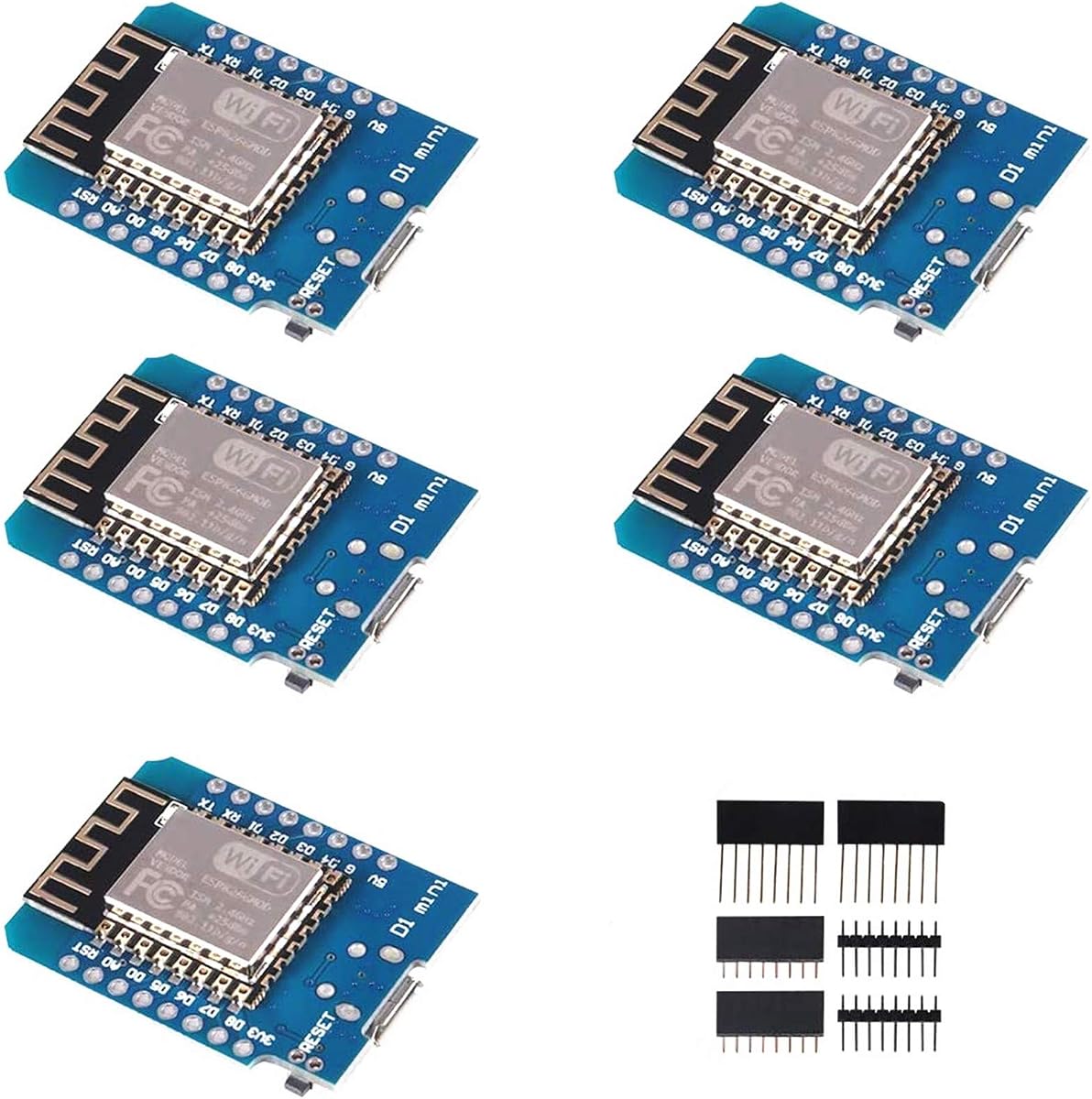
This pack features D1 mini boards based on the ESP-12F chip. With a 4.5 rating they offer 11 digital input output pins all with interrupts. They include onboard switching power supply and Micro USB connection for easy power.
We may earn a commission when you buy through this link, at no additional cost to you.
Compatible with Arduino IDE and Lua programming they are versatile for development. The onboard fuse protects against overcurrent during operation. They are smaller than full NodeMCU boards but larger than ESP-01 modules.
The USB interface makes them very easy to connect without extra adapters. This is excellent for users wanting ready to use WiFi boards. It is a good balance between convenience and connectivity.
Choose these if you need breakout pin headers already present. The onboard power and USB interface simplify the setup process. They are ideal for quick prototyping and home automation projects.
An onboard switching power supply eliminates the need for external power regulation.
Multiple digital pins allow connection to sensors, displays, and other peripherals simultaneously.
We may earn a commission when you buy through this link, at no additional cost to you.
This 10-pack is perfect for large scale deployments or educational workshops. With a perfect 5.0 rating it provides consistent wireless transceiver capabilities. The robust processing supports complex algorithms and tasks effectively.
We may earn a commission when you buy through this link, at no additional cost to you.
Each unit offers ample storage for data retention. The AP STA and AP+STA modes provide versatile networking options for any scenario. It streamlines compatibility with Arduino platforms using LWIP standards.
With ten units you have enough for many projects or sharing. The compact design saves space but requires careful soldering or adapters. It is a highly rated option for reliability.
If you need a large volume of reliable modules this is the best choice. It reduces the risk of running out of units during development. It delivers excellent value for bulk purchasing.
Getting ten modules offers high utility and ensures spares are available for testing.
Multiple mode support allows the devices to adapt to different network configurations easily.
We may earn a commission when you buy through this link, at no additional cost to you.
Selecting the right module involves evaluating processing power, connectivity options, and ease of use for your specific needs.
Modern boards often use dual core processors like ESP32 or ESP8266 for better performance. A faster processor ensures smoother execution of complex algorithms and simultaneous tasks.
Prioritize dual core options if you need to handle data processing while maintaining network connections.
Check if the module supports Wi-Fi 5.0 or Bluetooth for modern device compatibility. Newer standards offer better range and stability compared to older protocols.
Look for Bluetooth 5.0 or 4.2 support if your project requires wireless sensor integration or control.
Flash memory determines how much code and data you can store on the device. Higher capacity allows for complex sketches and over-the-air updates.
Choose modules with at least 4MB flash if you plan on storing data locally or running advanced scripts.
Many WiFi modules run on 3.3V so you need to ensure your system matches this voltage to avoid damage. Low power modes are crucial for battery operated applications.
Select boards with sleep and deep sleep features to extend battery life for remote devices.
Ports like USB-C or micro USB simplify programming and power supply. Some modules also support industrial protocols like CAN for specialized applications.
Modern USB-C interfaces are preferred for easier connection and higher data transfer speeds.
Compact modules like ESP-01 fit into tight spaces but may require extra breakout boards. Larger boards provide built-in pins and easier handling for beginners.
Decide if you need a small footprint for wearables or larger boards for prototyping ease.
Ensure the module is recognized by the Arduino IDE or MicroPython environments. Some require specific board selections to program correctly.
Check documentation for board manager links to ensure smooth software installation.
Buying in bulk often saves money and ensures you have spares for experiments. A single unit might be enough for testing but multiple units help with scaling.
Consider packs of 3 to 10 if you plan to build multiple nodes for a network.
Begin by connecting the module to your Arduino board or a breakout board that matches its voltage level. Ensure power and ground connections are secure to avoid communication errors.
Install the necessary drivers and board manager packages in your Arduino IDE to recognize the specific module model. This step is crucial for successful code uploads and debugging.
Protect the module from moisture and physical stress when building final products. Use heat sinks if the device runs hot during intensive operations to ensure longevity.
Many modules like ESP-01 require a USB-to-serial adapter or a breakout board for easier connection. However boards with built-in USB like UNO R4 or ESP32 do not need extra adapters.
Yes these modules are designed for home automation tasks like smart lights and sensors. They connect easily to cloud services and local networks for remote control.
ESP32 offers dual core processing and Bluetooth support while ESP8266 is single core with only Wi-Fi. ESP32 is more powerful for complex projects requiring multitasking.
Many advanced boards support OTA updates which allow firmware changes without physical connection. Check specific product specs to confirm this feature is available.
Most WiFi modules run on 3.3V. Connecting them to 5V directly can damage them so always check the voltage requirements before powering.
Some boards like Arduino Nano ESP32 and ESP32 variants support MicroPython. This allows coding in Python which simplifies the development process for many users.
We reviewed ten top options including the versatile UNO R4 and budget friendly ESP8266 variants. Each offers unique strengths for different project requirements and skill levels.
Prioritize modules that match your voltage and connectivity needs to ensure smooth integration. Consider power efficiency if your project will be battery operated or deployed remotely.
Remember to check current availability and verify specifications before purchasing. Technology evolves quickly so staying updated with the latest models ensures better performance.