
D-FantiX Battery Tester for AAA AA C D 9V, Universal Battery Charge Checker
4.5Editor score
No battery required to operate
Analog display with color coded scale
Small and practical for home use
This guide compares the top battery testers for household batteries to help you find the most accurate and reliable device for checking AA AAA C D and 9V cells.
Keeping your household gadgets powered requires knowing when batteries are truly dead. A reliable battery tester helps you avoid guessing and wasting money on replacements that still have life left in them.
We compared ten leading battery testers based on compatibility, accuracy, display clarity, and ease of use. Our analysis covers digital and analog options suitable for various common household battery types found around the home.
Each pick below highlights specific strengths like compact design or versatile testing slots. Please note that product availability and pricing can change frequently on retailer sites so check current details before purchasing.
4.5Editor score

4.5Editor score

4.6Editor score
The following table provides a side-by-side comparison of all ten selected battery testers. It highlights key specifications and features to help you quickly identify the best match for your specific needs.

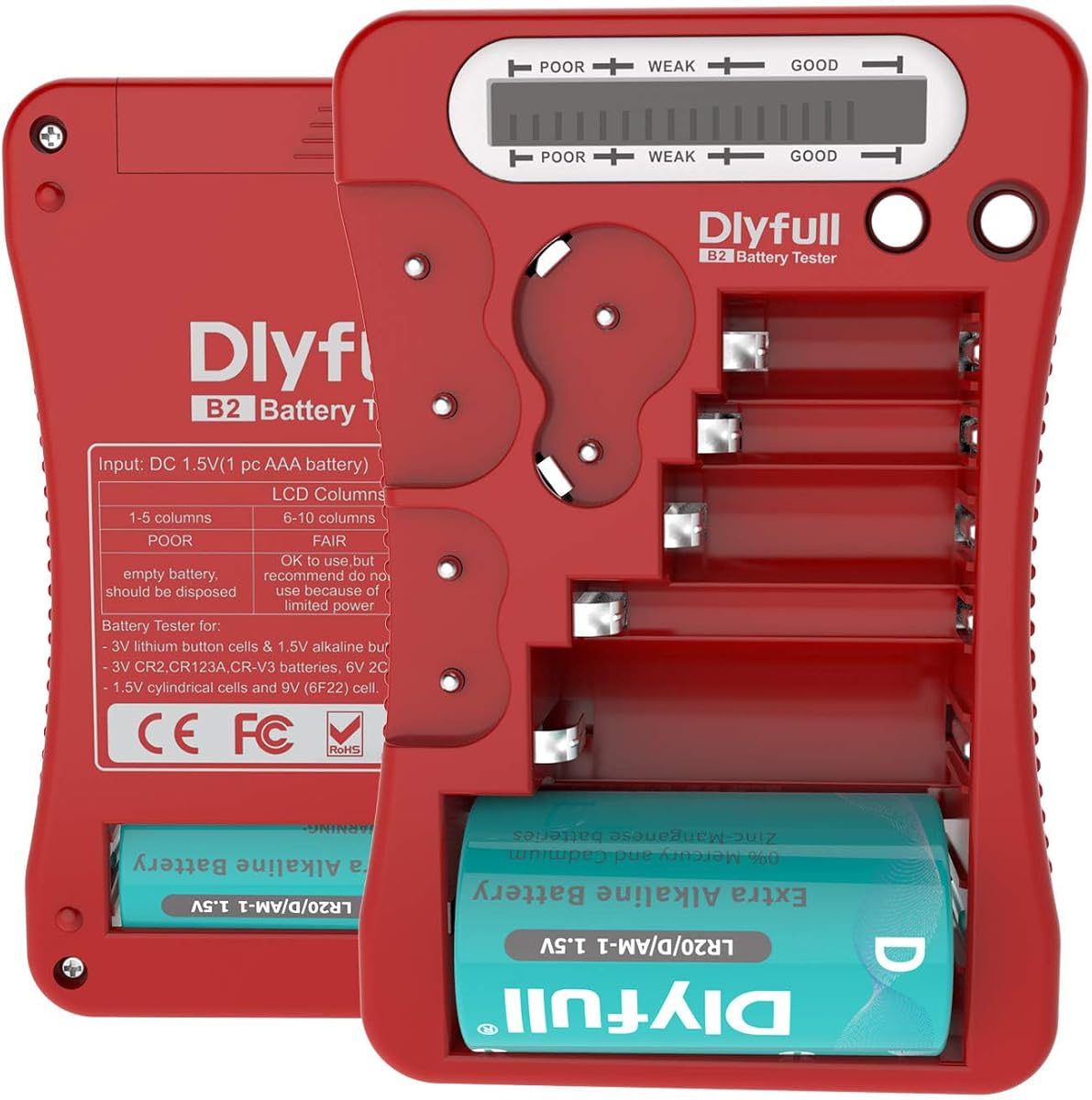


This Dlyfull battery tester stands out as a top choice for household use due to its broad compatibility and clear display. It holds a strong rating and is designed to give you quick insights into your battery health without complexity.
We may earn a commission when you buy through this link, at no additional cost to you.
The device features a crisp LCD screen that accurately shows whether a battery is in poor, weak, or good condition. Its high compatibility allows you to test AA AAA C D 9V and various button cell batteries making it versatile for many devices.
While it excels in standard battery testing, it does not support rechargeable batteries which is a limitation to consider. Additionally it requires an AAA battery to operate which means you need to ensure power is available when you need to test.
This model is ideal for homeowners who want a reliable tool to manage disposable batteries across toys remotes and flashlights. Its compact size ensures it fits easily in drawers or tool boxes for convenient storage and quick access.
Supports a variety of cylindrical and button cell batteries for versatile household use.
The LCD screen provides immediate health status readings to prevent unnecessary replacements.
We may earn a commission when you buy through this link, at no additional cost to you.
This battery checker distinguishes itself with real-load testing capabilities that provide precise voltage readings and power level indicators. It is particularly useful for users who need to test rechargeable options alongside standard household batteries.
We may earn a commission when you buy through this link, at no additional cost to you.
The device features a clear LCD display showing exact voltage plus a colored power indicator bar. It supports versatile multi-battery design including AA AAA C D 9V and various button cells while uniquely testing 1.2V rechargeable AA AAA and AAAA batteries.
While the real-load testing is a significant advantage the screen lacks a backlight which might make reading difficult in low light conditions. Also it requires an AAA battery for operation and does not include a storage case for the device.
This tester is best suited for those who value technical accuracy and need to manage both alkaline and rechargeable battery stocks. Its durable construction and patent pending design suggest long-lasting performance for frequent testing needs at home.
Uses specific discharge resistors to simulate actual usage conditions for accurate results.
Uniquely tests 1.2V rechargeable batteries to ensure safe and effective checks.
We may earn a commission when you buy through this link, at no additional cost to you.
This Dlyfull model is another strong contender known for its remarkable compactness and efficiency. It shares many features with other models in its line but focuses on ease of use for quick household battery checks.
We may earn a commission when you buy through this link, at no additional cost to you.
The crisp LCD screen allows you to easily see if a battery is in poor weak or good condition. Its high compatibility covers AA AAA C D 9V and button cell batteries ensuring you can test most common types around your home.
One trade-off is that it does not test rechargeable batteries which may limit utility for those with many rechargeable devices. It also requires an AAA battery to operate which is a standard convenience but adds to ongoing maintenance needs.
This device is perfect for users who prioritize portability and quick results. Its small and light design makes it easy to carry in a pocket or store in a small drawer ensuring you always have a tool handy when needed.
One of the smallest and lightest portable battery checkers available on the market.
Instantly shows battery health using clear bars to avoid unnecessary recharges.
We may earn a commission when you buy through this link, at no additional cost to you.
The D-FantiX Battery Tester offers excellent value by eliminating the need for an internal battery to operate. It is a small and practical tool designed for home use with a simple analog display that is easy to interpret.
We may earn a commission when you buy through this link, at no additional cost to you.
This universal tester works with standard and rechargeable household batteries including AA AAA C D 9V and button types. The analog display needle moves on a color coded calibrated scale to quickly identify good low and replace recharge status.
While the analog display is simple it may not offer the same precision as digital screens. It also requires manual reading of the needle which might be less intuitive for some users compared to digital readouts.
This is an ideal choice for budget conscious shoppers who need a basic tool for occasional testing. Its simplicity and lack of internal power needs make it a low maintenance addition to any household toolkit.
Activated by the battery being checked so no internal batteries are ever required.
Color coded scale provides immediate good low or replace recommendations at a glance.
We may earn a commission when you buy through this link, at no additional cost to you.
This La Crosse tester is praised for its straightforward operation that makes testing batteries quick and intuitive. It is designed to handle both alkaline and rechargeable batteries with a clear LED display for readings.
We may earn a commission when you buy through this link, at no additional cost to you.
The device features simple operation in three easy steps involving selecting voltage range inserting the battery and sliding the tray closed. It works for all AAA AA C D N 9V batteries and Lithium Ion button cells with multiple type selections.
While the tray mechanism is user friendly it is a mechanical part that could potentially wear over time with heavy use. Users must also manually select the correct voltage range for accurate results which adds a small step to testing.
This model is excellent for those who prefer a guided process for testing various battery types. Its ability to handle lithium button cells and rechargeables makes it a versatile choice for complex household electronics needs.
Three step workflow ensures correct connection and accurate voltage range selection every time.
Specifically supports Lithium Ion button cell testing which many basic testers miss.
We may earn a commission when you buy through this link, at no additional cost to you.
This product offers value by providing two battery testers in a single package. It is designed to give accurate readings of voltage levels for common household batteries without requiring any internal battery to operate.
We may earn a commission when you buy through this link, at no additional cost to you.
The testers feature easy to read indicator bars that show the battery's power level. They are lightweight and small enough to fit easily into your pocket making them convenient for on-the-go use wherever you need them.
While the dual pack offers convenience the display quality may be more basic compared to advanced digital units. It also lacks advanced features like rechargeable testing which might limit utility for tech heavy households.
This is a great option for families who want multiple testers to keep in different locations like the garage and workshop. The no battery requirement ensures they are always ready to use without maintenance checks.
Includes two testers so you can keep one in the car and one at home.
Requires no battery for operation ensuring it works whenever you need a quick check.
We may earn a commission when you buy through this link, at no additional cost to you.
The Tenergy T-333 is an inexpensive unit designed to add to your household electronics must-haves. It easily checks battery statuses for most general household batteries with just one device and clear LCD feedback.
We may earn a commission when you buy through this link, at no additional cost to you.
It works with a variety of popular household battery types including AAA AA C D 9V and CR123A CR2 CRV3 2CR5 CR-P2 and various button cell batteries. This makes it a versatile tool for checking devices across your home.
The unit is powered by a single AAA battery which is included in the package to get started. While this adds convenience it means you will eventually need to replace that internal battery to keep it functional.
This model is ideal for general home use where a broad range of battery types need checking. Its low power design and compact form factor make it a practical addition to any electronics toolkit.
Supports over a dozen battery sizes including specialty ones like CR123A and 2CR5.
Powered by one AAA battery ensuring low power product that lasts a long time.
We may earn a commission when you buy through this link, at no additional cost to you.
The Gardner Bender GBT-500A is a robust analog battery tester designed for reliable performance. It includes test leads for easy testing and covers a wide range of battery types and voltages for various applications.
We may earn a commission when you buy through this link, at no additional cost to you.
This unit tests all common batteries to determine if they are charged or need replacement. With fourteen different battery ranges it can handle 1.5V button cells 12V 9V and lantern cells making it versatile for different projects.
While the analog design is durable the needle scale requires some skill to read accurately compared to digital displays. It is also larger than most portable pocket testers which may reduce convenience for quick checks.
This device is best suited for workshops or hobbyists who need a tool for varied battery types including higher voltage options. Its analog nature ensures it requires no internal power to function reliably.
Includes test leads that allow for flexible testing of batteries not easily inserted.
Handles everything from small 1.5V cells to larger 12V and 22.5V photo batteries.
We may earn a commission when you buy through this link, at no additional cost to you.
The Dlypow Magnetic Battery Tester offers an innovative approach to testing with a built-in magnetic tip that grabs and holds the battery in the ideal position. This ensures a stable signal for accurate measurements shown on the analog display.
We may earn a commission when you buy through this link, at no additional cost to you.
It is designed for everyone with a simple one-step process that delivers easy-to-read results in seconds. The tester works with all common household battery types including AAA AA C D 9V and button cells for daily device maintenance.
While the magnetic design improves stability the analog display might be less precise than digital screens for some users. Also it is limited to common battery sizes which might not cover all specialty cells you may encounter.
This model is perfect for those who want a user-friendly tool that minimizes the hassle of checking batteries. Its affordable price and durable build make it a smart investment to stop wasting money on unknown battery status.
The built-in magnetic tip ensures a secure contact for highly accurate measurements.
Simple one-step process and large display make it easy for anyone to use.
We may earn a commission when you buy through this link, at no additional cost to you.
This Dlyfull B4 Battery Health Tester provides robust compatibility with twelve battery types including various lithium and alkaline options. Its smart LCD display offers clear information about battery status in percentage and bar formats.
We may earn a commission when you buy through this link, at no additional cost to you.
The device supports a wide range of sizes and chemistries such as Ni-MH Zinc Air Alkaline and Li-ion. You can test cylindrical batteries using the negative pin while button and combination batteries use corresponding slots for testing.
It includes a self-test button to check the device own battery level ensuring reliable operation when needed. However it requires 1.5V AAA alkaline batteries to power this product which adds a dependency for usage.
This model is ideal for tech savvy users who need to test specific lithium types and track battery health precisely. Its lightweight design makes it convenient for carrying and storage for both home and field use.
The LCD screen shows precise voltage levels and percentage for detailed battery status.
Hold the check button for three seconds to run a self-test or error check.
We may earn a commission when you buy through this link, at no additional cost to you.
Selecting the right battery tester involves considering several factors to ensure it meets your specific household needs and budget.
Ensure the tester supports the specific sizes and chemistries you use most often. Some models handle only standard alkalines while others include rechargeables and lithium button cells.
Choose a device that covers the widest range of batteries you commonly encounter to maximize utility.
Look for a display that is easy to read in various lighting conditions. Digital screens often offer more precision while analog scales provide quick visual cues without needing power.
A clear screen ensures you can interpret the battery health status quickly and accurately.
Consider whether the tester requires its own power source like AAA batteries or if it operates passively. Passive testers are always ready but may offer fewer features.
If you prefer a digital device ensure it has good battery life to avoid interruption.
For convenience in storage a compact and lightweight design is preferable. Many users benefit from a tester that fits in a drawer or pocket for quick access.
A small chassis with an anti-slip finish can improve handling during testing.
Advanced models use real-load testing to simulate actual device usage which improves accuracy. Basic voltage readings might not always reflect performance under load.
Prioritize testers that offer realistic assessments of battery life to prevent unexpected failures.
A simple testing process saves time and frustration. Look for clear instructions and intuitive slots for inserting batteries without confusion.
User friendly tools ensure even family members can use them safely and effectively.
A sturdy construction ensures the tester lasts through regular use without damage. Check if the manufacturer offers a warranty for added peace of mind.
Quality materials and reliable engineering contribute to long term performance and trust.
Some testers include extra functions like self-test capabilities or storage cases for convenience. These features might add value depending on how frequently you test batteries.
Identify which extra functions are most useful for your workflow before purchasing.
To use most battery testers simply insert the battery into the correct slot ensuring proper polarity alignment. For analog models observe the needle position on the scale while digital models will show readings automatically.
For battery testers that require internal power ensure fresh batteries are installed to maintain accuracy. Regularly clean the contact points with a dry cloth to prevent corrosion from affecting readings.
Store your device in a dry place away from extreme temperatures to protect its electronics. Avoid dropping the tester as mechanical shocks can damage sensitive internal components or the display screen.
Not all testers work on every type so check compatibility before buying. Some models are designed for alkalines while others include rechargeables and lithium button cells.
Some testers require a small AAA battery to power their display while others run passively. Always check the product details to confirm if an internal power source is needed.
Digital testers generally provide more precise voltage readings while analog ones offer quick visual checks. Both can be reliable depending on the quality and testing method used.
Many modern testers support 1.2V rechargeable batteries but not all models do. Verify the product specifications to ensure it handles your specific rechargeable battery chemistry.
Test a known good battery or use the self-test function if available on your device. This ensures the unit is calibrated and functioning properly before relying on results.
It is a to wipe the contacts occasionally to remove dust or residue that could affect readings. Keeping the device clean maintains accuracy and prolongs its lifespan.
We have reviewed ten distinct battery testers each offering unique benefits for managing household power sources. Whether you need simplicity or advanced features there is an option suited to your specific requirements.
Prioritize compatibility and readability when selecting a model to ensure it serves your needs effectively. A reliable tester helps prevent waste by identifying batteries that still have usable life left.
Prices and availability may vary so check current listings before making your final purchase. Investing in a quality tool will pay off by keeping your gadgets powered and your home organized.