
2Pcs ADS1115
5.0Editor score
Low cost per unit
High accuracy
Wide voltage range
Multiple input modes
This guide compares the top Arduino ADC Board options for precision analog signal acquisition across various microcontroller projects and data logging tasks.
Selecting the right Arduino ADC Board is crucial for accurate analog signal measurement in your electronics projects. These modules convert continuous voltage signals into digital values that microcontrollers can process reliably.
We compared ten leading ADC boards based on resolution, channel count, communication interfaces, and compatibility with popular platforms like Arduino and Raspberry Pi to find the best options.
Each pick highlights key features, pros, cons, and ideal use cases. Please note that product availability and pricing can change frequently, so verify details before purchasing.
5.0Editor score

4.7Editor score

4.6Editor score
The following table provides a side-by-side comparison of all ten selected ADC boards, highlighting their key specifications to help you make an informed decision quickly.




This Teyleten Robot ADS1115 module stands out as a top choice for hobbyists and professionals seeking reliable analog-to-digital conversion. With a strong 4.7 rating, it delivers consistent performance across various applications.
We may earn a commission when you buy through this link, at no additional cost to you.
The ADS1115 chip provides 16-bit resolution with programmable gain, allowing you to measure small signals accurately. Its I2C interface simplifies wiring, requiring only two data lines plus power and ground.
While it offers a wide supply range and multiple input modes, the maximum sample rate of 860sps might be slow for high-frequency signal analysis. However, for most sensor data logging tasks, it is more than sufficient.
We recommend this board for users who need a balance of precision and ease of use. Its availability in a three-pack makes it an excellent value for projects requiring multiple ADC points.
The 16-bit resolution ensures fine granularity when converting analog voltages to digital values for detailed analysis.
You can configure channels for single-ended or differential inputs to adapt to various sensor types and requirements.
We may earn a commission when you buy through this link, at no additional cost to you.
For projects demanding exceptional precision, the HiLetgo ADS1256 offers a 24-bit resolution that surpasses standard 16-bit modules. It is ideal for measuring strain gauges or thermocouples where minute voltage changes matter.
We may earn a commission when you buy through this link, at no additional cost to you.
This module includes an onboard voltage reference and supports up to 8 single-ended or 4 differential inputs. Its SPI communication allows for faster data transfer rates compared to I2C options.
The trade-off is increased complexity in wiring and library setup. You must manage SPI lines carefully and ensure your microcontroller can handle the protocol efficiently without conflicts.
This board is best suited for advanced users who need high accuracy and do not mind the extra setup effort. It is a powerful tool for professional data acquisition applications.
With nonlinearity as low as ±0.0010%, this ADC provides extremely accurate readings for critical measurements.
The ability to handle 8 inputs means you can monitor more sensors without adding multiple separate modules.
We may earn a commission when you buy through this link, at no additional cost to you.
The 2Pcs ADS1115 module offers an unbeatable price point without sacrificing essential features. It maintains the high quality of the ADS1115 chip, making it perfect for students or large-scale deployments.
We may earn a commission when you buy through this link, at no additional cost to you.
You get programmable data rates and seven input voltage ranges to suit different signal levels. Its I2C interface makes it easy to chain multiple units for expanded channel counts.
Some users might find the physical construction basic compared to more expensive boards, but functionally it performs reliably. The lack of extensive documentation means you may need to rely on community libraries.
If you are looking for an affordable entry into precision ADCs, this is the top choice. It proves that cost-effective solutions can still deliver accurate and stable results.
Get 16-bit accuracy for a fraction of the cost of more specialized data acquisition systems.
Multiple units can be addressed on the same bus to increase your input capacity easily.
We may earn a commission when you buy through this link, at no additional cost to you.
This three-pack from HiLetgo provides excellent value for projects requiring multiple ADC points. Each board supports 16-bit conversion with programmable gain, ensuring flexibility in your sensor readings.
We may earn a commission when you buy through this link, at no additional cost to you.
It operates effectively across a wide voltage range and supports comparator mode for threshold detection. The I2C protocol simplifies connections, reducing clutter in complex setups.
While the rating is slightly lower, likely due to occasional quality variations, the functionality remains solid for most users. You may need to solder headers yourself if they are not pre-installed.
Ideal for classrooms or batch projects where multiple ADC boards are needed at once. It is a practical solution for spreading conversion capability across many devices.
Comparator mode allows you to set thresholds for automatic triggering without constant polling.
Three units in one package mean you can outfit several projects simultaneously without extra orders.
We may earn a commission when you buy through this link, at no additional cost to you.
Offering four modules in a single order, this set is perfect for extensive sensor arrays or networked monitoring systems. Each unit provides the standard 16-bit precision you expect from ADS1115 chips.
We may earn a commission when you buy through this link, at no additional cost to you.
Features include auto shut-down modes to save power and onboard oscillators for stable timing. The differential input support helps reduce noise in environments with electrical interference.
Users have noted that while the chips work well, the packaging or physical components may vary. For bulk applications, this does not impact performance, but handling requires care.
This option is best for industrial prototypes or home automation where you need many channels. It balances quantity and quality effectively for large projects.
Auto shut-down features help extend battery life in portable or remote sensing applications.
Differential inputs allow you to cancel common-mode noise for cleaner signal acquisition.
We may earn a commission when you buy through this link, at no additional cost to you.
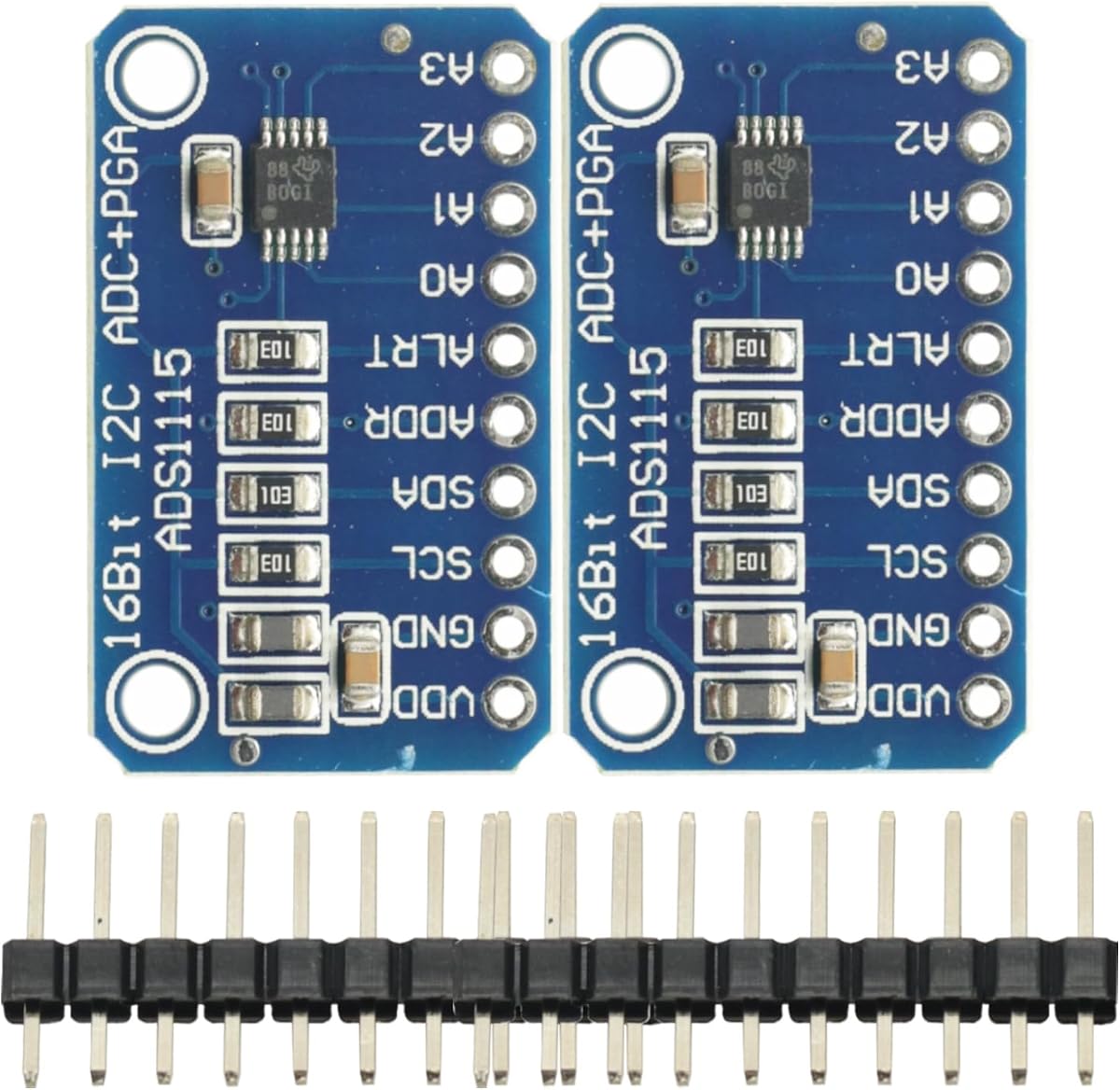
With a perfect 5.0 rating, this ADS1115 pair delivers reliable performance for general ADC tasks. It is an excellent choice for anyone needing straightforward analog measurement.
We may earn a commission when you buy through this link, at no additional cost to you.
The module supports a wide voltage range and includes seven programmable input ranges. Address pins allow for easy expansion if you need more inputs without complex hardware changes.
There are no special premium features, which keeps the cost low and functionality focused. It is a workhorse module that gets the job done consistently for standard applications.
We recommend this for projects where stability and cost are key factors. It is a safe bet for any electronics enthusiast looking for precision conversion.
Address pin configuration makes it easy to add more channels without changing your bus setup.
Support for 2.0V to 5.5V means it works with both 3.3V and 5V systems seamlessly.
We may earn a commission when you buy through this link, at no additional cost to you.
Lonely Binary distinguishes itself with ENIG gold plating, which improves solderability and resistance to oxidation. This makes the board more durable over long-term projects and storage.
We may earn a commission when you buy through this link, at no additional cost to you.
Each module is ready for use with pre-soldered headers, saving you time on assembly. The brand focuses on open-source compatibility, ensuring library support across multiple ecosystems.
While the price is higher than generic options, the build quality and reliability justify the cost for professional or educational use. It is a refined product for serious makers.
Choose this board if you value component longevity and ease of use. It is particularly well-suited for classroom environments where durability matters.
Gold plating ensures that contact points remain clean and conductive over time.
Pre-soldered headers mean you can start prototyping immediately without additional soldering.
We may earn a commission when you buy through this link, at no additional cost to you.
The AD7606 module is unique because it supports synchronous sampling across 8 channels at up to 200KHz. This is rare for hobbyist ADCs and valuable for power line or audio analysis.
We may earn a commission when you buy through this link, at no additional cost to you.
It can handle high voltage inputs directly, which simplifies designs for industrial power monitoring. The parallel output mode allows for very fast data transfer to compatible microcontrollers.
However, the complexity of setting up high-speed sampling and SPI can be daunting for beginners. Lower ratings might reflect the difficulty in integrating it smoothly into standard projects.
This module is ideal for specialized engineering projects requiring synchronized high-speed data. It is not a general-purpose ADC but excels in its niche.
Synchronous sampling ensures all channels read data at the exact same time for phase analysis.
Input ranges up to ±10V allow direct connection to mains or industrial signals with minimal attenuation.
We may earn a commission when you buy through this link, at no additional cost to you.
This four-pack is a solid investment for DIY electronics and data acquisition projects. It offers consistent high-resolution conversion that is compatible with most microcontrollers.
We may earn a commission when you buy through this link, at no additional cost to you.
The modules are designed to be easy to integrate into existing systems with minimal wiring. They are particularly useful for reading various sensors like temperature or pressure accurately.
As a bulk kit, it focuses on function over form. There are no advanced features beyond the standard ADS1115 capabilities, but that ensures broad compatibility.
Recommend this for projects that need multiple analog points spread across different locations. It is a practical choice for monitoring systems.
Support for Arduino, ESP32, and STM32 ensures it fits into almost any current project.
Gain amplification makes it easier to read low-voltage sensors without extra circuitry.
We may earn a commission when you buy through this link, at no additional cost to you.
This single board version from HiLetgo provides a standard ADS1115 solution that works reliably. It is an excellent choice if you need just one ADC without committing to a large pack.
We may earn a commission when you buy through this link, at no additional cost to you.
Features include programmable gain and comparator modes for flexibility. The wide supply range ensures it can power up easily on standard breadboards.
Since it is sold individually, you may pay slightly more per unit compared to bulk packs. However, it is convenient for quick prototypes or spare components.
We suggest this if you want a simple, reliable ADC without extra overhead. It is a proven design for many existing projects.
Simple layout and clear pinout make it ideal for quick testing and development.
Competitive pricing makes it an accessible option for those needing a single unit.
We may earn a commission when you buy through this link, at no additional cost to you.
Selecting the right ADC board depends on your specific project needs. Below are key factors to consider before making a purchase.
Resolution determines the smallest voltage change the ADC can detect. Higher bit resolutions like 24-bit provide finer detail, while 16-bit is sufficient for most general sensors.
Choose 16-bit for standard tasks and 24-bit for high-precision instruments like strain gauges.
Consider how many analog signals you need to measure simultaneously. Some boards offer four channels, while others provide eight or more for expanded data points.
Ensure the channel count matches your sensor requirements to avoid adding multiple modules unnecessarily.
Interfaces like I2C and SPI affect wiring complexity and data speed. I2C is easier to wire but slower, while SPI allows faster transfer rates with more wires.
Select I2C for simplicity and SPI if your project requires high-speed sampling.
Check if the module supports your microcontroller's logic voltage. Most boards accept 2.0V to 5.5V, but logic level compatibility is essential to prevent damage.
Verify that the input voltage range matches your system power to ensure safe operation.
A programmable gain amplifier (PGA) helps you adjust sensitivity for different signal levels. This is useful for amplifying small signals from low-voltage sensors.
Look for boards with PGA if you work with micro-volt level sensors.
Build quality impacts longevity and reliability. Boards with gold plating or robust components are more resistant to corrosion and wear over time.
Invest in higher-quality boards for industrial or long-term deployments.
The sample rate defines how quickly the ADC can convert analog signals to digital values. Higher rates are needed for dynamic signals like audio or vibration.
Choose a sample rate that meets your application's frequency requirements.
Buying in multi-packs often reduces the cost per unit significantly. This is beneficial if you need multiple ADC boards for distributed sensor networks.
Evaluate if a bulk pack offers better value for your project scale.
Connect the board to your microcontroller using the appropriate interface wires. For I2C, link SDA to SDA and SCL to SCL, ensuring you share common power and ground lines.
Install compatible libraries for your development environment to simplify reading data. Most boards have open-source libraries available on GitHub or package managers.
Store unused boards in anti-static bags to prevent damage from moisture or electrostatic discharge. Handle the pins carefully to avoid bending or breaking them during use.
I2C uses two wires for data and is simpler to wire but slower. SPI uses more wires but offers faster data transfer rates, which is better for high-frequency signals.
Yes, most modern ADC boards like the ADS1115 support a wide voltage range from 2.0V to 5.5V, making them compatible with both 3.3V and 5V systems.
Some boards come with pre-soldered headers, while others require you to solder them yourself. Check the product description to see what is included.
Most 16-bit ADCs like the ADS1115 have a maximum sample rate around 860 samples per second, whereas specialized models like the AD7606 can reach 200,000 samples per second.
Yes, these ADC boards are widely compatible with Raspberry Pi models that support GPIO pins and I2C or SPI interfaces, making them ideal for data logging projects.
Use a library like Adafruit ADS1x15 to simplify communication. Initialize the library and read values from specific channels using simple functions in your code.
We highlighted top picks like the Teyleten Robot ADS1115 for general use and HiLetgo ADS1256 for high precision. Each board offers unique benefits depending on your project needs.
Prioritize resolution and channel count based on your specific sensor requirements. Ensure compatibility with your microcontroller to avoid integration issues.
Prices and availability change frequently, so always check the latest details before ordering. Use our links to find the best deals for your next project.